X
X
Top

Blog

  1. /
  2. Blog

Don’t Put Music on the Backburner

It’s back-to-school time! New clothes, new books, new classes—lots of new assignments and maybe new teachers and new friends too—football, track, theater, “In The Know” team, science club… With a new workload and endless possibilities, it might seem impossible to find the time for guitar or piano lessons, let alone the time for daily practice.

It’s time to prioritize. Just because you can’t get an hour a day to practice doesn’t mean you shouldn’t bother! Schedule a time every day that is your practice time, even if it’s only 15 minutes. Make it part of your daily routine. Like brushing your teeth or walking the dog, it’s just part of your day.

At Whitney Music, we make every effort to be as flexible and accommodating as we can. We understand that your team needs you, or that the play can’t go on without you. Given enough notice, we are usually able to find lesson times that fit even the most demanding extracurricular schedule.

Don’t put music on the back burner; keep it up. We know you can!

Free Intro to Guitar Class

Our Introduction to Guitar Class is our free offering to the Columbus community. Is Grandma’s old guitar gathering dust in the closet? Maybe you received one as a gift and just haven’t got around to learning to play it yet? This is a great opportunity to get started! All ages are welcome, but children under 10 should be accompanied by an adult.

The class is about an hour long and held in our Clintonville music studio at 4601 N.High Street. You’ll learn how to tune the guitar and strum a couple of chords. All you need is a guitar (be sure it has all 6 strings!), a love of music and a little patience.

See our Events Calendar for your next opportunity to participate.

A Beginner’s Guide to Choosing Your First Guitar


1. Go to a guitar store
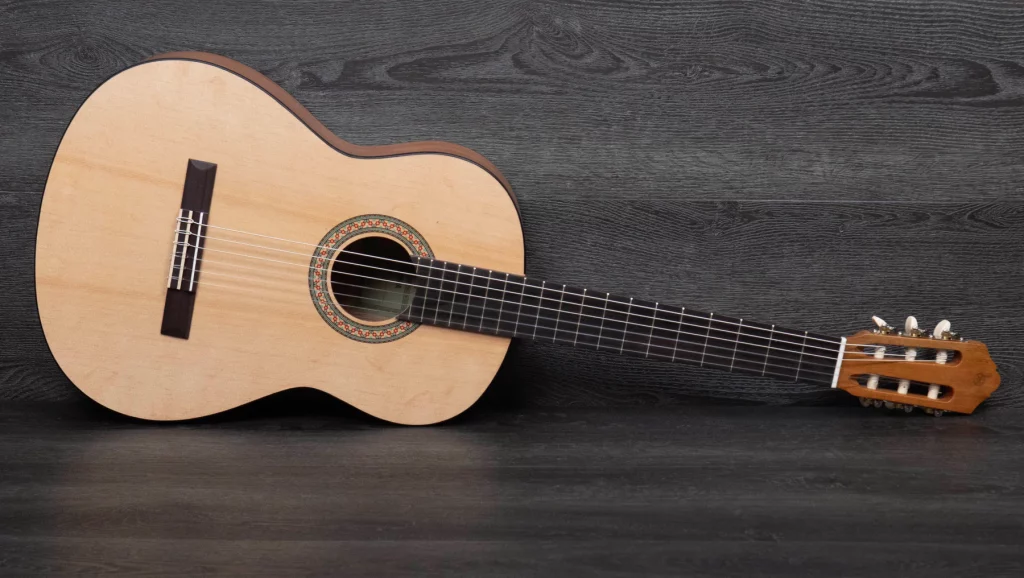
2. Ask for a Yamaha C40
3. Buy it.

Well… okay, maybe there’s a little more to it than that…

1. Why a guitar store (or music retailer of any kind, i.e., Sam Ash) as opposed to a pawn shop, department store, or online? A music retailer is more likely to know their product and have some quality control. This means you are less likely to get a dud that needs to be returned. Stay away from department stores altogether; you’ll never find a decent guitar at a department store. If you have a friend or family member who knows about guitars and can help, a pawn shop or online is okay, but could be a headache if you have a problem.

2. Why Yamaha? It’s simple – their quality control is second to none at any price level. As for the C40, it’s a full-size nylon-string classical acoustic for about $130. Nylon strings hold less tension and are softer than steel strings, making them easier to play for beginners. If you really want a steel-string acoustic or electric guitar, then go ahead and get one (it won’t be that much harder to play). Yamaha makes great steel-string acoustics. Yamaha electric guitars don’t seem to be very popular; therefore, you don’t see too many of them in shops. Ibanez, Epiphone, and Schecter make some good entry-level electrics. Of course Gibson and Fender still make excellent electrics, but they cost a bit more. Hey, if you’ve got the money, go for it!

3. Buy the correct size. If you are buying for a child, you may want to consider a half-size or 7/8-size guitar. Yamaha has offerings of classical guitars in both of these sizes. A sales person at a reputable music store should be able to help in fitting your child with the right size guitar.

When it comes to buying an instrument, you cannot skimp on quality! The good news is a guitar of acceptable quality should be attainable for less than $200. That’s pretty cheap in the world of musical instruments.

Finally, after you make that purchase, find a good teacher (like me) and practice every day!

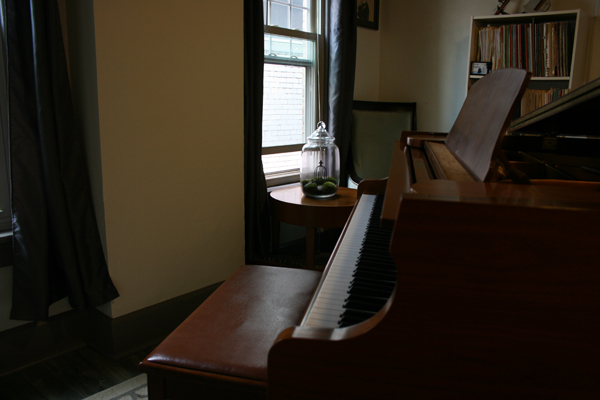
Grand Opening Photos

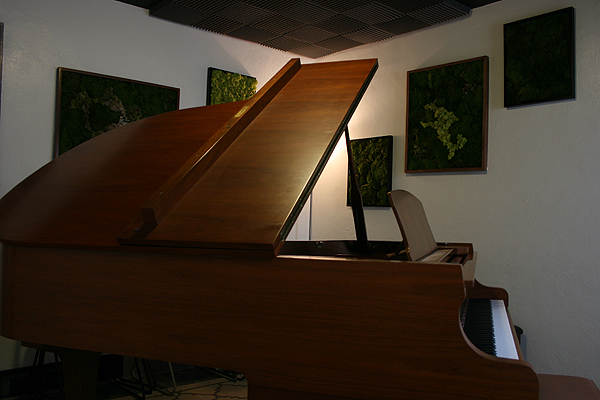
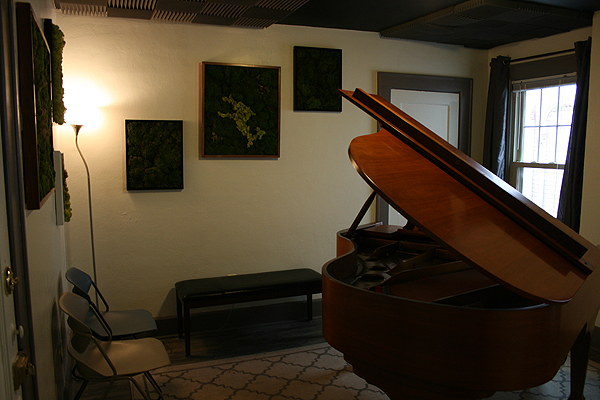
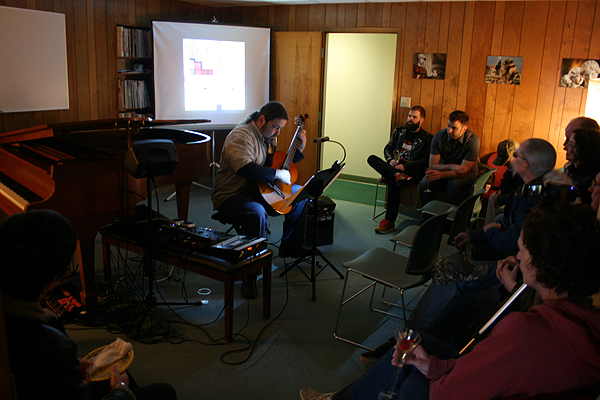
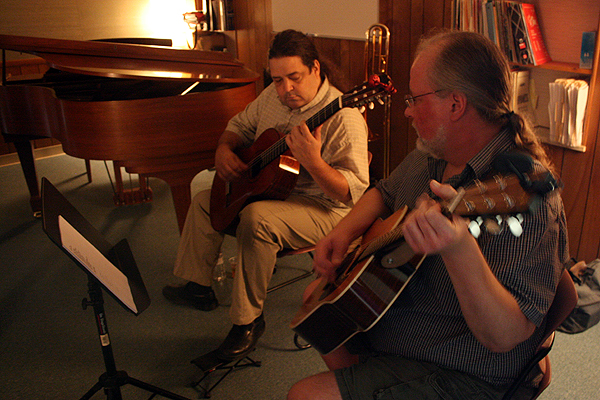
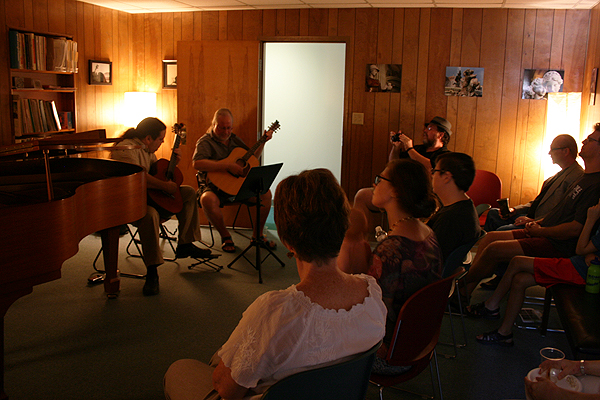
Over the weekend, we celebrated a grand (re)opening of our studios and invited local illustrator Kasandra Murray to exhibit a collection of her art prints, which are available for sale in our upstairs art space through the holidays. The entire neighborhood was invited to join us for open-house style afternoon of food and drink, live music, and local art as we got settled into our new location.

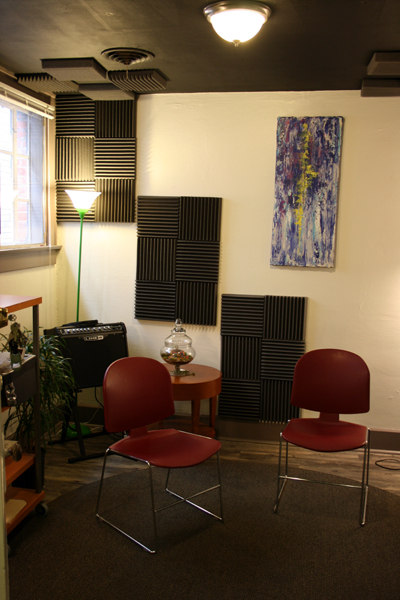
Check out these photos of our newly remodeled studios and the work of our featured artist:

Adventures in Soundproofing

Well, we’ve moved into our new music teaching studios in Clintonville and the place is a gigantic echo chamber. Our old studio had wall-to-wall carpet, dry wall covered with thin wood paneling and a drop ceiling packed with insulation. It was like playing music inside a giant marshmallow. The new place, built in 1938, has plaster ceiling, plaster walls and faux wood flooring. It’s like playing music in a cave. We need to tame this wild beast!

Our first thought was to call an expert contractor to thoroughly soundproof our office suite. Of course this is a bit cost prohibitive to say the least. Fortunately, DIY soundproofing is a common practice. Our new guitar and piano teaching studios won’t really be soundproof, but a little sound diffusion goes a long way.

We’re starting with simple foam acoustic panels. They come in 12 inch squares with ridges, like a potato chip. We found a seller who ships them to us 48 at a time for pretty cheap. The first thing we want to do is put some on the ceiling, keeping in mind that these will have to come off some day. Our solution is to fix them 3×2 to a piece of cardboard using spray glue and attach the larger panels using command strips. Genius!

We made about 5 panels before we ran out of spray glue and so far things are looking pretty good. Off to the hardware store for more glue, then the real test, fixing them to the ceiling. We’ll let you know how it goes.

Cheers!

Techniques of Impressionism Concert

Just a few weeks ago, a few of the piano students of Annalisa Ventola presented a summer concert/lecture on the techniques of Impressionism at Graves Piano and Organ on Karl Road (Columbus, Ohio). Throughout the concert, students and concert attendees learned about such turn of the century compositional techniques as writing with modes, displaced harmonies, pedal points, and organizing music without a tonal center.

All of the students prepared their pieces well over the summer, and it was one of our best concerts ever. Have a look at the (abridged) program below.

Modal Melodies Exploring tonalities beyond major and minor scales
Eliza T.On the Ocean Floor, from The OceanHansi Alt
Hannah M.Enfantillages pittoresques (Quaint Childishness)1.  Petit prélude à la journée (Little Prelude for the Day)2. Berceuse (Lullaby)3. Marche du grand escalier (On the Grand Staircase) Displaced HarmoniesSimultaneous occurrences of multiple tonalitiesErik Satie
Gabriel T.The Vast Expanse of SpaceVladimir Rebikov
Sydney E.Jumping Jack, from Humorous BagatellesCarl Nielsen
Tsunami B.Le Palais Abandonné (The Abandoned Palace) from Histoires (Stories) Jacques Ibert
Pedal Point
Defining a tonal center using sustained bass notes
Brenen R.Le Soir (The Evening) Op. 43, No.5Reinhold Gliere
Marla S.Clair de Lune (Moonlight)Claude Debussy
Disintegrating Tonality
Organizing music without a tonal center
Nathaniel T.Prelude No. 2from Three PreludesCharles Griffes

Jamil Wilson: Bio and Upcoming Performance

Jamil Wilson has loved the piano for as long as he can remember. He discovered his love of music at six years old when he first started playing tunes by ear on his grandmother’s grand piano. Being extremely interested in jazz and R&B, he took up band at school and played the tenor and alto saxophone while still experimenting on the piano. In a short amount of time, he learned to play several impressive tunes on both instruments by listening to songs on the radio. After Jamil moved from his hometown in Knox County to Columbus, he had to give up the saxophone, which, although heartbreaking, allowed him to focus more on learning to play the piano.

During the move, Jamil stayed with his grandmother and once again learned to play songs from the smooth jazz radio station until he and his family finally moved into their home. Fortunately, his family moved right down the street from Whitney Music. Excited, he convinced his parents to let him take lessons outside of school. Under the guidance and supervision of his piano teacher, Annalisa, he refined his repertoire and learned music theory, reading, technique, and piano performance practices.

It wasn’t until much later in his freshman year of high school that he discovered his vocal talents. While auditioning for the musical Bye Bye Birdie his freshman year, the choir and music theory teacher at school was impressed with his singing abilities and cast him as the understudy for the leading male role. After the play, his teacher persuaded him to become a part of the school’s choir. Despite being unsure and nervous, Jamil joined the choir, and eventually became the tenor section leader of the group.

After being on stage numerous times and performing in a number of solos, duets, trios, and quartets, he had finally found his calling. Now reveling in both singing and piano, it was only a matter of time before he would put them together. Jamil wrote his first song with singing and piano accompaniment, A Love Deferred (inspired by a Langston Hughes poem), sometime in his sophomore year. It was a huge hit…for his family, as well as some of his teachers, who inspired him, gave him advice, and insisted that he do more. As time wore on, he composed many more piano arrangements as well as pop vocal scores. He has played numerous recital pieces sponsored by Whitney Music, and performed as a solo vocalist for President Obama during his visit to Fort Hayes High School in 2011.

Now as high school comes to a close and he continues his music studies at Cleveland State University, he would like to thank Ms. Annalisa his piano teacher; his school’s vocal teacher Mr. Daryl Flemming, as well as his mother Tamuve Wilson, father Elbert Wilson, his entire family, and especially his grandmother, Granny Cain who was one of the first to help him discover his love of music.

Join us as Jamil Wilson performs his senior recital on August 4th, 3:30pm, at Graves Piano & Organ Recital Hall.

Dance Forms

Preparations are underway for the next piano recital on August 4th. We decided that the theme would be dance music this year, inspired by an amazing box of sheet music that a friend rescued from the OSU dance department. The studio suddenly found itself in possession of many rare and wonderful contemporary folios from the 1930s–1960s, and we wanted to put them to good use.

Many people aren’t aware that much of the classical piano literature we encounter on a daily basis was actually composed for parties and dancing! A minuet, for example, is a dance in 3/4 time and considered the precursor of the waltz. Other dance forms include the allemande, sarabande, bouree, chaconne, and galliard. Check out this exhaustive list of dance forms at wikipedia:

http://en.wikipedia.org/wiki/List_of_dances

So the students have been reviewing potential recital pieces and have been settling on their choices over the last couple of weeks. True to usual form, it will be an entire summer of dance music as we all take a break from our lesson books and use the summer months to strengthen our repertoires and explore the theme.

Effigy

Subscription to our newsletter open soon.

© 2026 Built with love by WolfThemes • Privacy Policy • Store Policy • Terms & Condition